|
TESOL International Association began creating formal
affiliation agreements with other language teacher associations in 1969
when nine organizations applied for and were granted affiliate status.
If you look at our current bylaws, however, they say very little about the purpose of
affiliation. They simply state: “Geographically based, autonomous
organizations that support the mission of TESOL may become TESOL
Affiliates” (Article V). As president this year, I have
had the distinct honor to speak at a number of affiliate conferences
and interact with representatives from associations around the world. I
know how much both TESOL and our affiliates value this relation. But
why?
The TESOL Board of Directors has been grappling with this
question for several years. In a recent post
on the TESOL President’s blog, I describe an overall review of
governance structures and processes that the association has been
engaged in since 2010. As part of that effort, we struck a task force to
examine and make recommendations regarding our affiliation program. In
the TESOL Affiliate News September 2016 newsletter,
Past President Andy Curtis wrote a detailed
account of the work and recommendations
of that task force. Of the recommendations that Curtis highlighted in
his account, the first was “the purpose of the partnership must be
clearly defined” and the second was that “a common vision or plan is
necessary.”
In December 2016, the board shared with affiliate membership
and leadership a proposal
for a new vision for our affiliate program and ideas on how an Affiliate Network Professional Council
could be used to advise TESOL. The proposal argues that the relation
must be based on four touchstones: (1) respect for the independence of
all parties, (2) the significance of these relations for the field and
profession, (3) flexibility to allow the relation to manifest in diverse
ways, and (4) mutuality of benefits.
For me, the heart of this proposal is a recognition of what we
can accomplish if we work together. Currently, more than 100 language
teacher associations based in the United States as well as countries
around the world have chosen to become TESOL affiliates. Though TESOL
has roughly 12,000 members, when we bring together the membership of all
our affiliate associations, that number swells to more than 45,000.
These numbers give our field a voice, a voice we are using this
year at our Summit on the Future of
the TESOL Profession where one of the themes is the
profession as a change agent. When we work together as a worldwide
profession, we can promote research on issues that cut across contexts.
We can share our resources and expertise to provide quality professional
learning opportunities online and in person that are locally relevant
but also informed by the latest voices from around the world. We can
access the learning achievements being made in other places to share
with our local policy makers.
TESOL has a clear mission:
“to advance the quality of English language teaching through
professional development, research, standards, and advocacy.” As an
association, we recognize that we can do this better when we work with
our affiliates. As the convener of a worldwide network of affiliates, we
believe that we also can help you achieve your respective missions.
Whenever I write something about achieving missions, I know that there
are cynics who ask what that really means. In this case, the hard
currency that will enrich both TESOL and our affiliates will be
increased access to information; electronic tools that structure
interactions; and collaborations on specific projects, such as regional
conferences or gathering data on the status of the profession worldwide.
As an appointed group of members with expertise in local and
international association leadership, the proposed Affiliate Network
Professional Council will be tasked with detailing our shared vision
even further, actively looking for collaboration opportunities and
advising TESOL on procedures for implementing the relation. In short,
this group will be tasked with holding us all to account and reminding
us of our mutual interests.
If you have not had the chance to read the proposal
yet, I hope you will. The Board of Directors will be discussing
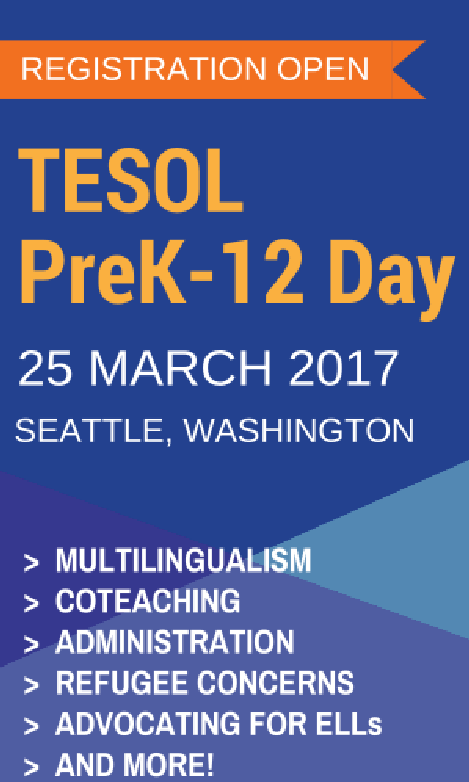
language for implementing this as an association policy at its March
2017 meeting prior to the Seattle convention. We will then discuss our
most current vision with the Affiliate Assembly during the convention
and plan to vote on a new Affiliate Relation policy shortly after that.
As with all revisions to TESOL’s governance, we actively seek input and
ideas.
Dudley Reynolds is the 2016–17 president of TESOL
International Association and a teaching professor of English at
Carnegie Mellon University in Qatar, where he teaches first-year
writing. Over his career, he has also taught elementary school learners
in Egypt, intensive English students at Indiana University, and MA TESOL
candidates at the University of Houston. His research focuses on
teacher development and second language literacy issues. During his
presidential term, he has learned greatly from invitations to speak at
TESOL affiliate conferences in Kuwait, Saudi Arabia, Venezuela,
Pakistan, Italy, Thailand, and the United Arab Emirates. |