|
Bolivia has not been indifferent to the changes in the world
panorama that have been brewing since the First and Second World Wars.
Franz Tamayo, in his remarkable essay, “The Creation of National
Pedagogy,” published in 1910, laid the foundations for specialized
education in a language that went beyond Castilian and demonstrated the
value of retaining cultural identity by promoting the use of the first
language in the study of foreign languages
With a similar vision, the Bolivian state, through the Bolivian
Education Code of 1955 and Law 1565 of Educational Reform, recognizes
and respects students’ native languages and in turn promotes the
gradual teaching of the English language in the public schools of the
state’s urban centers. Today, the Bolivian Education Law Project,
"Avelino Siñani and Elizardo Pérez," recognizes that education must
begin with the mother tongue and that the foreign language must be
taught from the earliest school years.
English teachers in Bolivia needed instruction to improve their
ELT methodology. A number of organizations hoped to address this need:
The Department of Language Careers and the Department of Linguistics
within different public universities sought to develop the humanistic
skills of their students from modern methods of language
training.
It was thus that with the passage of time and amalgamating
ideas, the Department of Native and Foreign Languages of the Royal and Pontificial Major University of Saint Francis Xavier of Chuquisaca (RMPSFXCH),
headed by Lic. Juan Hinojosa G., outlined what would come to be called
the English-Language Teaching Project UK-Bolivia. In 1990, this was sent
to the British Embassy in the city of La Paz.
The British Embassy in Bolivia was willing to provide better
teaching and learning conditions to Bolivian teachers, so they were
willing to pay attention to the needs of those raised by them.
On instructions from the British Embassy, the British Council
was immediately placed in the service of language teachers while
seeking sufficient resources and funds to deal with the project to be
financed by the British Government. Subsequently, arrangements were made
for the arrival from London of Dr. Myra Harrison, ELT consultant from
the Department of Overseas Development and Administration, who would
visit Bolivia and attend meetings with four public
universities.
The results were far from expected. In June 1992, the
English-Language Teaching Project UK-Bolivia was formalized by means of a
letter sent by R. M. Jackson to then Minister of Foreign Affairs and
Worship of the Bolivian Government, Mr. Ronald MacLean Abaroa.
Cooperation funds and technical assistance for the development of
English language teaching in colleges and universities were
secured.
The scope of the project would include the following cities and
their respective public universities: La Paz, Cochabamba, Sucre, and
Santa Cruz initially, later extending to Oruro, Tarija, and Potosí.
Formation of the Bolivian English Teachers Association
The British Government's technical and financial cooperation
would have a finite duration, so the British counterpart suggested that
language teachers should organize themselves through an entity that
could not only unite them as teachers, but could also provide them with
training opportunities for continuous improvement. English teachers from
the cities of Cochabamba, Sucre, Santa Cruz, La Paz, Oruro, Potosí, and
Tarija resolved to found the Bolivian English Teachers Association
(BETA) for exclusively pedagogical purposes for the defense and
improvement of English language teaching techniques.
From the BETA Principles
-
Ensure the solid training of our human resources through
dynamic instruments to place Bolivian education in line with the demands
of the country and world change processes. This is based on the active
participation of the cultural enterprise of the community through
extracurricular activities endorsed with the declaration of human
rights.
-
Strengthen, dignify, and contribute to the integral education
of students of both sexes in English language learning within the
principles of national sovereignty, respect, and revaluation of the
cultural, historical, and psychosocial values of our people.
-
Convene congresses, seminars, and conferences actively
participating in technical-pedagogical, cultural, and social
events.
-
Represent English teachers in all activities, procedures, and
defense before the authorities of the Ministry of Education,
etc.
-
Contribute to, disseminate, and promote the development of
technical-pedagogical science and culture in all its
manifestations.
-
Associate to watch and fight for ethical, professional, and moral right and also for teaching and professional improvement.
From the Ends of BETA
-
Seek the exchange of experiences, correlation, and sequence in English language teaching.
-
Ensure that the educational system is integrated into the
principles of Universal Science, because the human being has the right
to equal opportunity to universal culture and to complete and enrich
cultural education and language learning in the service of children,
young people, and adults who require this service.
-
To create and guarantee aspirations by finding the viable
path to fulfill the immediate and mediate objectives of BETA.
-
Supplement texts or
booklets about basic or technical English with appropriate vocabulary
and lexicology.
-
Organize summer courses for teachers of specialties, refresher courses during pedagogical holidays or during the school year according to the educational system.
-
Exchange experiences at teaching or extracurricular events,
including application of modern systems in modern English teaching, and
share techniques, methods, and procedures within educational
technology.
-
Seek cultural exchange with other similar international organizations, embassies, and ministries.
-
Procure scholarship procedures for postgraduate studies and specialization.
-
Seek interdisciplinary relationships with Bolivian
universities, particularly with the Faculties of Humanities, with the
Language Careers, Institutes of National Linguistics in order to plan
improvement and updating courses for English teachers.
BETA Organizational Structure
BETA is entirely and exclusively made up of English language
teachers. It is the academic teaching organization of Bolivian English
teachers, on a par with excellence, constituted by:
- Born Members
- National Directory
- Departmental Directory
The National Conventions of English Teachers are held once a
year in January. These are an opportunity to share educational
experiences related to pedagogy, methodology, grammar, phonetics, and
the use of new information technologies. See Table 1 for a list of
recent BELTA conventions.
Table 1. Recent BELTA National Conventions
|
Year |
Convention |
Location |
Attendees |
|
2014 |
19th |
Cochabamba; Bolivian Catholic University |
800 |
|
2015 |
20th |
La Paz; Católica Boliviana San Pablo University |
280 |
|
2016 |
21st |
Chuquisaca; Royal
and Pontificial Major University of Saint Francis Xavier of Chuquisaca (MRPSFXCH) |
800 |
|
2017 |
22nd |
Oruro; Jesus Maria School |
340 |
Important Achievements of BETA
Among the praiseworthy achievements of BETA as an academic
institution that ensures the excellence of English language teaching, we
can highlight:
-
Consolidation to change the National Convention of Teachers of English every year in different cities of Bolivia to involve all English teachers in this country.
-
The obtaining of a ministerial administrative resolution that
allows the English language teacher graduates of the different fiscal
universities of Bolivia to enter the national ranking of the teaching
profession and consequently to be recognized as foreign language
teachers for the Bolivian State.
-
Success in including the document Curricular Proposal for
Teaching - English Language Learning in the education bill, "Avelino
Siñani and Elizardo Pérez."
BETA currently has eight departmental subsidiaries throughout
the country. Each and every one of them is duly constituted and
represented before the national assembly.
BETA as a TESOL Affiliate
Today, BETA members are happy for the opportunity to be part of
an international association like TESOL International Association.
Since BETA joined TESOL as an affiliate 8 years ago, it has experienced
changes. Belonging to an institution that has worked hard for more than
50 years in the latest technological advances with respect to teaching a
second language has more than updated BELTA and its members. Today, we
have the advantage of having great professionals and experts who are
constantly researching and working at the service not only of a whole
country but of the whole world—a world that changes every day.
Bolivia still needs to research and work to have a good
educational system, and thanks to foreign countries we can feel that we
are achieving good results. Being a third word country does not take away the effort of teachers and
students to learn and to be better every day. Besides, BETA is proud to
be part of an international association where millions of people come
together to exchange experiences and discover new cultures. The
opportunity to have been in the biggest educational events—TESOL
international conventions—motivates and pushes us to be better. Fortunately BETA, with the help of the American Embassy and sponsors, has the opportunity to have great professionals and experts from TESOL International Association in Bolivia to transmit their experiences at Bolivia TESOL Annual Convention.
That is why BETA, which today is called BOLIVIA TESOL, is
working more than ever to live up to a new generation with very high
goals and to meet expectations in teaching a second language.
Reference
Tamayo, F. (2009, Nov. 7) (page 18) Creation of National
pedagogy. (1910). Number 2 of the Library of the Sesquicentennial of the
Republic. Contribute El Diario, La Paz, Bolivia. Edition 3. Publisher
Library of the Sesquicentennial of the Republic, 1975. Origin of the
original University of Texas. Retrieved from https://books.google.es/books?id=F8MQAAAAYAAJ&dq=editions:LCCN77579719&hl=es
Image 1
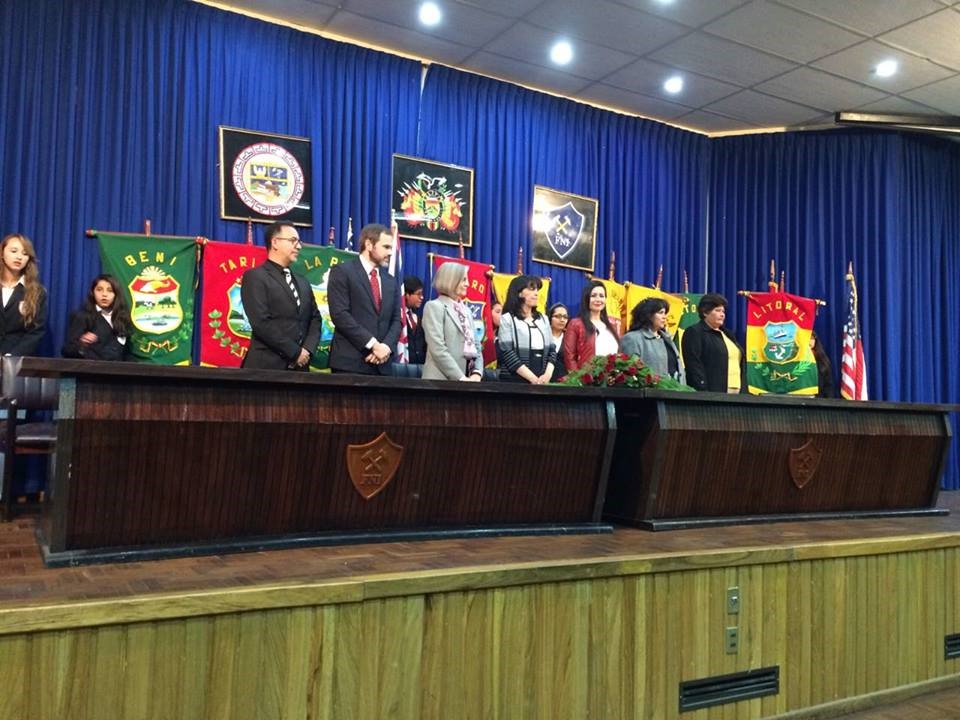
Source: Picture from Daniela Balderrama Rocha in Oruro, Bolivia
on 8 January 2017.
Isela Coronado Melgar received her undergraduate
degree in English language and postgraduate degree in English for
specific purposes and higher education. She is president of the Bolivian
English Teachers Association in the city of Santa Cruz, where she
promotes workshops and regional conventions. |